Round barns and covered bridges route
Rare architectural treasures in the Eastern Townships
Along the roads of the Eastern Townships, round barns and covered bridges shape a landscape rich in heritage and meaning. These iconic structures bear witness to exceptional agricultural and craft traditions, telling the story of a territory shaped by human ingenuity, British and American influences, and a deep connection to rural life.
Developed in the 19th century, round barns were inspired by the Shakers of New England and stand out for their circular design, both symbolic and highly functional. Once common, fewer than ten remain today in the Eastern Townships. These rare architectural gems reflect a pivotal moment in the development of Québec’s dairy industry, as well as a pursuit of balance between utility, beauty and innovation.
Covered bridges reveal another chapter of rural history. Introduced to Québec in the 19th century under American influence, these wooden structures were designed to protect their frames from the elements and ensure the durability of an expanding road network. While more than 1,200 once spanned Québec’s waterways, only a small number survive today. Restored, preserved or pedestrianized, they remain powerful symbols of collective memory.
Traveling the Round Barns and Covered Bridges Route invites visitors to slow down, admire these rare structures, and immerse themselves in landscapes where architecture, territory and storytelling come together.


Round barn Stanley-Holmes
2523, chemin Holmes , Barnston-Ouest Website
Status: Private property
Style: Three-level wooden round barn
Year built: 1907
Original function: Cattle shelter and hay storage
Historical background
William Henry Holmes commissioned Willis Cramer, owner of a sawmill in Way’s Mills, to build this round barn to replace a stable that had been destroyed by fire. Drawing on expertise acquired in Vermont, Cramer applied his skills to complete this remarkable and unconventional structure.
According to Stanley Holmes, the idea of building a round barn, a type of structure still uncommon in Québec at the time, came to his grandfather during his stays in Massachusetts. There, as in several neighbouring U.S. states, this architectural model was enjoying growing popularity.
Distinctive features
At first glance, this round barn impresses with its distinctive circular shape and imposing scale, making it one of the largest of its kind in Québec. Its three-level structure, accessed by a covered ramp known as a garnaud leading to the upper floor, reflects exceptional ingenuity. Topped with a gabled dormer, the barn features a broken circular roof crowned by a central cupola. These elements, both functional and aesthetic, contribute to its exceptional character and iconic appearance.
Anecdote
Stanley Holmes himself invested nearly $100,000 and received financial assistance from the government to ensure the preservation of this heritage building. The owner remains deeply committed to maintaining this historic gem.
During your visit
Although this round barn is a private property and cannot be visited from the inside, it remains a must-see stop along the route. Visitors are invited to pause to admire its remarkable architecture, take photographs and observe its distinctive features from the exterior. The surrounding area is also ideal for a short walk, offering an opportunity to enjoy the rural landscape and appreciate how the barn is harmoniously integrated into its setting, while respecting the peace and privacy of the site.

West Brome round barn
35, chemin Scott , Lac-Brome Website
Build in 1915-1916, it hasn’t been in use for several years, but it’s still remarkably well preserved. It cedar shingles, its pinched sheet metal roof, its dormers and its pretty turret all contribute to its olden day charm.
Source: Tourisme Cantons-de-l'Est.
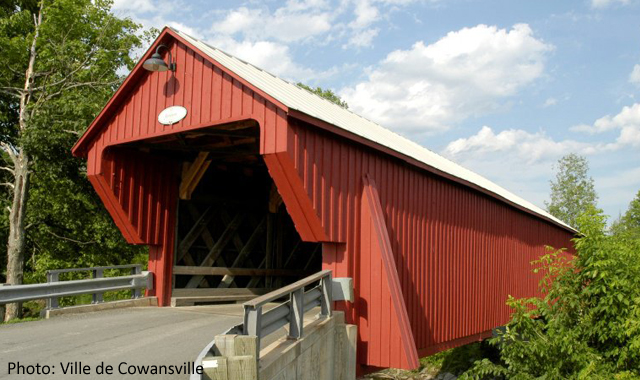

The Walbridge Barn
189, chemin de Mystic, Saint-Ignace-de-Stanbridge Website
Classified as a provincial historic building in May 2004, the Walbridge Barn in Mystic (St. Ignace-de-Stanbridge) Quebec, is one of the most beautiful gems of Quebec’s architectural heritage. This dodecagonal (12-sided) barn is the only one of its kind in the province.
Source: Musée Missisquoi

McVetty-McKenzie covered bridge
151 Route 257, Lingwick J0B 2Z0 Website
Founded in 1807 the Township of Lingwick welcomed its first settlers in 1838. These immigrants, ousted from their farms in the isle of Lewis in Scotland which have since been transformed into pastures, settled on lands granted to the British American Land Co.
On December 21, 1892, a tender in the amount of $4,314 from J. & I.A. McKenzie and William McVetty was selected for the construction of the stone foundation of the bridge and the wood structure. In 1893, the bridge was completed to the council's satisfaction.
Following the construction of a new bridge, the covered bridge has not been in service since 1950 having been declared a heritage site since 2003 and has become a gathering place.
Source: Waymarking.com


De la Frontiere Covered bridge
Chemin Bellevue, Canton de Potton J0E 1X0 Website
The Pont de la Frontière was built in 1896, near the northern border of the State of Vermont. It is found on Chemin Bellevue where it spans a deep gorge on the Mud Brook. A walking trail is located upstream from the bridge beginning near the province Hill Cemetery and leads to the brook side,where a splendid view of the bridge is to be seen.
The covered bridge was retired from use in 1960 after more than 75 years of loyal service. It was cited as a historic monument on October 6, 2008.
Source: Potton.ca

Mansonvile round barn
25 Rue Joseph Blanchet, Mansonville J0E 1X0 Website
Built in 1911, the Mansonville round barn, with its clapboard siding, has three stories and a tin roof topped with a cupola and gable roof dormers. Thanks to several contributions and grants, plus many donations, a lot of restoration work is being carried out to return it to its lustre of the past.
Once completed, this barn will become an interpretation centre for the region’s agricultural, forest and landscape built heritage.
Source: Easterntownships.org
At present, you can only admire the round barn from the outside, as the interior is closed for an indefinite period. Due to non-conformities, the site represents a hazard for users. The Municipality is currently assessing the situation.

Paul-Émile-Giguère covered bridge
210 Chemin Porter, Ulverton J0B 2B0 Website
Covered Bridge Mill was once used by merchants and residents in the area to bring the wool mill. It was restored in 1993. The day after the inauguration, a arsonist set fire to the bridge. From the week that followed, many administrators and volunteers were busy fundraising to enable reconstruction. The covered bridge Ulverton Woolen Mill is the only bridge with an automatic fire protection. The covered bridge was restored a third, a bright red.
source: QuebecPanorama

Baldwin Mills round barn
1282, chemin de Baldwin Mills-Barnston,, Coaticook Website
As you head out to Mount Pinacle or to the beach at Lyster Lake, you’ll find the biggest round barn of the Townships right here on the Baldwin Mills-Barnston road. Even though it hasn’t been used since 2009, and although it really needs a lot of love, it still offers a fine glimpse of the past with its cedar shingle siding and its pretty turret.
Source: easterntownships.org


Eustis covered Bridge
Chemin Astbury, Waterville J0B 3H0 Website
The Eustis Bridge, which was built back in 1908, is one of only three remaining covered bridges in Quebec that feature a construction type known as the multiple kingpost truss.
The Eustis Bridge takes its name from a once-thriving copper mining village of the same name, a community that a century ago boasted a large mining complex, dozens of company houses, a general store, a church, a train station, and even a baseball team. Today, few traces of the village remain, apart from copper slag, the occasional house, and, of course, the covered bridge.
Source: http://townshipsheritage.com

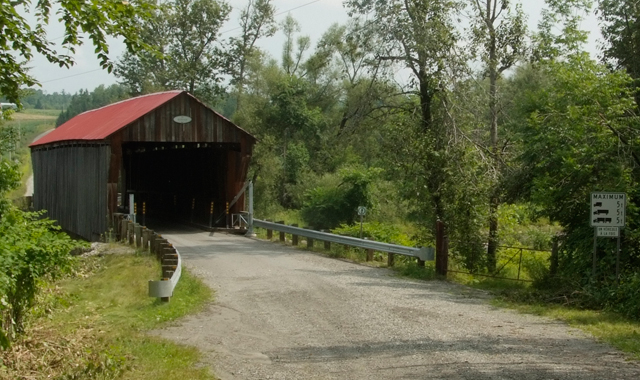

Narrows Covered Bridge
685 chemin Narrows, Stanstead Website
A hundred and twenty years after it was built, and twenty-five years after it was by-passed, the covered bridge over the Fitch Bay Narrows is still standing. Located along Highway 247 between Beebe (Stanstead) and Georgeville, the old bridge, with its newer concrete cousin not far away, sits at the foot of two steep ridges that rise on either side of Fitch Bay, which is a long offshoot (almost a fjord, in fact) of Lake Memphremagog. The bridge spans the bay at its narrowest point -- hence its name "Narrows Bridge."
Source: townshipsheritage.com
